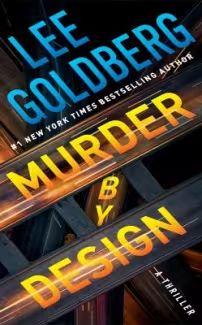
Interview With an Author: Lee Goldberg

Lee Goldberg is the #1 New York Times bestselling author of more than seventy novels, including the Eve Ronin series, the Ian Ludlow series, the Sharpe & Walker series, and five books (and two novellas) in the Fox and O’Hare series, which he co-authored with Janet Evanovich. He also co-created the Hallmark movie series Mystery 101 and has written and/or produced many TV shows, including You’re Killing Me, Diagnosis Murder, SeaQuest, and Monk. As an international television consultant, he has advised networks and studios in Canada, France, Germany, Spain, China, Sweden, and the Netherlands on the creation, writing, and production of episodic series. He lives with his family in Southern California. His latest novel is Murder by Design, and he recently talked about it with Daryl Maxwell for the LAPL Blog.
What was your inspiration for Murder by Design?
I was struck by a quote from architect and theorist Bernard Tschumi, who said the best way to understand architecture is to commit a murder. That led me to devour books on design… and to create a character who solves murders by understanding architecture and the elements of design. And I wanted to honor the traditions of the genre while subverting them—and that’s how Edison Bixby was born.
Are Wally, McGregor, Melissa, or any of the other characters in the novel inspired by or based on specific individuals?
Nope. That said, Wally was inspired by some ridiculously self-absorbed actors I’ve met over the years who take their work and themselves a bit too seriously.
Similar question for Edison Bixby (Because I think there may be a story here)?
Nope.
How did the novel evolve and change as you wrote and revised it? Are there any characters or scenes that were lost in the process that you wish had made it to the published version?
No, that never happens. I know where I am going before I start writing the book. I write an outline... which is about ten pages long. So I know exactly what is going to happen. I am not discovering the story as I write.
And then, to get the story out of my system and to see if it works, I write it first as a screenplay. I have no intention of selling that script, or showing it to anyone (and it’s usually two to three times longer than a feature script, about 250 pages). I do this script for myself. I let dialogue and action drive the story... and I don’t worry about the details. I just want to find the rhythm of the story and to see if it works. Once I’ve finished the script, which takes about three weeks, I know if I have a book... or if I don’t. And then I spend the next few months novelizing my screenplay, coloring between the lines, and adding the details (forensics, locations, etc).
In your Author’s Note, you describe how you had to do a bit of research to be able to see the world the way that Edison Bixby does. You go on to provide a bit of suggested reading for readers who may want to investigate how they are influenced and impacted by the objects and constructs that surround them. How long did you research this prior to writing Murder by Design?
That’s not so much a list of suggested reading as it is a bibliography, a detailed list of the books, research papers, and articles that I read to educate myself on how Edison Bixby sees the world. It’s my way of telling the reader that I didn’t make this stuff up; the science is real. The only reason it seems fantastical is that most of us have never thought to look at our world as an almost entirely man-made environment. Very few of us live outside of the built world (buildings, roads, trails, etc), and nobody can get by without using tools (whether it’s a computer or a hammer, a car or a fork) to achieve our personal and professional needs and goals. But once you start seeing it all, you can’t unsee it. And that’s Edison Bixby’s superpower... or weakness. It’s all he can see. He can’t blind himself to it anymore, the way we all have.
What was the most interesting or surprising thing (or two) that you learned during your research?
Just how much of our lives are manipulated and controlled by designed spaces and objects... and, conversely, how much we need and want designed spaces and objects. We accept the trade-off. But all creatures use design to survive. Even nature uses design.
Are Edison Bixby’s or Archibald Twain’s houses inspired by real locations? If so, what are they and where are they?
Edison Bixby’s home was inspired by a real home in the Santa Monica Mountains (since destroyed by the Woolsey fire) and all the "storybook" homes you can find throughout Southern California.
The real house was designed and built by the late Gary Richardson, who was an architect, carpenter, furniture-maker, and contractor. His house looked like a natural, organic extension of the trees around it, a tree house that wasn’t in a tree, but was one itself, if you can imagine that. The theme continued inside, with his custom wood furniture, a bathroom featuring intricate inlaid timber, a living room dominated by a massive stone fireplace, and a cellar fashioned out of a preexisting natural cave. But that wasn’t all. The whole property was amazing. It’s a shame nobody can see it.
But you can see the storybook homes that inspired me. They’ve been around for decades. They first started appearing here with the birth of the movie industry in the early twentieth century and would eventually spread throughout Southern California, the state, and even the nation.
The Witch House is perhaps the most famous and enduring example of the storybook style. It was designed and constructed by movie art director Harold G. Oliver in 1921 as the administration building and dressing rooms for the Willat Studios in Culver City. Six years later, the building was moved to Beverly Hills and repurposed as a home. It’s still standing today at 516 North Walden Avenue and was one of my inspirations for Edison Bixby’s home. You can learn more about the house, and many others like it, in the wonderful book Storybook Style: America’s Whimsical Homes of the 1920s by Arrol Gellner and Douglas Keister.
Archibald Twain’s snail-like house was probably inspired by the giant snail in the original Doctor Doolittle movie starring Rex Harrison… and, to some degree, by architect Antoni Gaudí’s famous buildings and park in Barcelona.
You’ve written short stories, novels, and multiple book series. Some of those series are tied to television series where you’ve also worked as a screenwriter and a producer. On top of all of that, you’ve also written non-fiction titles as well. Is there a format that you prefer over the others?
They all use a different muscle. When I was writing for the Monk TV series... and also writing the Monk novels, they were two very different ways of telling stories about the character. I could work on a Monk script during the day and a Monk novel at night because they didn’t feel like the same thing at all. Because they are two different mediums.
I love writing books… but I also love writing scripts. I suppose what I love most is telling stories. So I’d say I prefer that to my non-fiction work, most of which is related to television history and production. And I prefer writing for television to writing feature scripts... because the TV stuff actually gets made. There’s also far less time for creative meddling by development executives.
Is there something you haven’t done yet but are hoping to have the opportunity to try?
Yes, adapt one of my books into a movie or TV series and see it made. I’ve come soooooooo close many, many times, but it hasn’t happened yet.
Otherwise, in terms of professional writing, I’m the luckiest SOB I know. I’ve done just about everything. I’ve written and published novels, non-fiction books, TV reference works, short stories, novellas, and hundreds of articles…and I’ve written and produced teleplays, screenplays, and documentaries. I’ve also directed a few short films. Probably the only kind of dramatic writing I haven’t done is a stage play, and I really have no interest in doing that.
I’d like to write a western novel... though that genre is in hospice care publishing, so it’s probably unlikely I’ll ever do it. It makes no financial sense. Besides, I’ve dabbled in the genre already. I wrote two books that jumped between the present day and the 1800s (Mr. Monk in Trouble and Calico), so perhaps that’s enough.
You are the eldest of four children, and your younger siblings, Karen Dinino, Tod Goldberg, and Linda Woods, are also writers. In addition, your uncle is true-crime author Burt Barer. Have you ever collaborated with any of your siblings? Have you all collaborated on a single project?
The closest I’ve come to a collaboration is providing a short story, "If I Were a Rich Man," to my brother Tod’s acclaimed anthology, Eight Very Bad Nights.
If/when Murder by Design is adapted into a film or series, who would your dream cast be?
I think Ryan Gosling, Ryan Reynolds, or Glen Powell would make a wonderful Edison Bixby.
Murder by Design is being promoted as the first in a new series of novels. When will readers be able to join Edison and Wally on their next adventure? What are your plans for the series?
I’ve just completed the sequel, The Invisible Architect, and it will be out in March 2027. It’s already available for preorder.
What’s currently on your nightstand?
I recently read John Sandford’s Revenge Prey and a wonderful little design book called Shikake: The Japanese Art of Shaping Behavior Through Design by Naohiro Matsumura. There are dozens of books on the TBR pile, including Sacrament by Susan Straight, Beartooth by Callan Wink, Night Moves by Alan Sharp, and the mammoth Tom’s Crossing by Mark Danielewski. The nightstand might collapse.
Can you name your top five favorite or most influential authors?
Larry McMurtry. Elmore Leonard. Robert B. Parker (his early work). Gregory McDonald (specifically Fletch, and Confess Fletch).
What was your favorite book when you were a child?
I didn’t have a single favorite book when I was a kid. I read so much. I loved the Hardy Boys. I read every single one in existence…and I loved the westerns by William O. Steele.
Was there a book you felt you needed to hide from your parents?
Never. My parents encouraged me to read anything and everything I wanted to. There were no boundaries. In fact, when I was in 6th grade, I wanted to read The Godfather, and our local B. Dalton wouldn’t sell it to me. So my Mom marched me into the store, hunted down the manager, and told him to tell his employees to sell me any book I wanted to read. The manager smirked and said, “What about The Joy of Sex?” And Mom said, “he doesn’t need to buy it, I have it and the sequel if he wants to read them.”
Is there a book you’ve faked reading?
Nope. That would be like faking an orgasm.
Can you name a book you’ve bought for the cover?
This Suitcase is Going to Explode by Tom Ardies. It had this cool cover that changed depending on how you turned it to the light.
Is there a book that changed your life?
Fletch by Gregory McDonald. The dialogue was so good that the publisher put a page of it on the front cover. It was the first time I read a great crime story told primarily through dialogue. Yet it was every bit as rich, in character and plot, as far wordier and less dialogue-driven books. I studied Fletch and Confess; Fletch the way some Jews study the Talmud. I didn’t have McDonald’s skill, but somehow I knew after reading his book that I could be a writer.
Can you name a book for which you are an evangelist (and you think everyone should read)?
Atlanta Deathwatch by Ralph Dennis. Or any of his 13 Hardman novels. The man was an unappreciated master of crime fiction.
Is there a book you would most want to read again for the first time?
Lonesome Dove by Larry McMurtry. It’s my favorite book of all time.
What is the last piece of art (music, movies, TV, more traditional art forms) that you’ve experienced or that has impacted you?
It’s been a very long time since I’ve seen a movie or read a book that’s significantly impacted me. I think the last novel I read that stuck with me for a while was North Woods by Daniel Mason... and, on the non-fiction side, The Design of Everyday Things by Don Norman, which changed how I look at the world... and was a huge influence on Murder by Design.
What is your idea of THE perfect day (where you could go anywhere/meet with anyone)?
A day with my family. Anywhere. It wouldn’t hurt if there were a beach, some BBQ, and an apple pie involved.
What is the question that you’re always hoping you’ll be asked, but never have been?
I’ve done hundreds of interviews and have been asked everything.
What are you working on now?
I am working as a writer/executive producer on the second season of the Acorn TV mystery series You’re Killing Me… and plotting my eighth Eve Ronin novel.