
City of Pop-Ups: Movable Books in Los Angeles


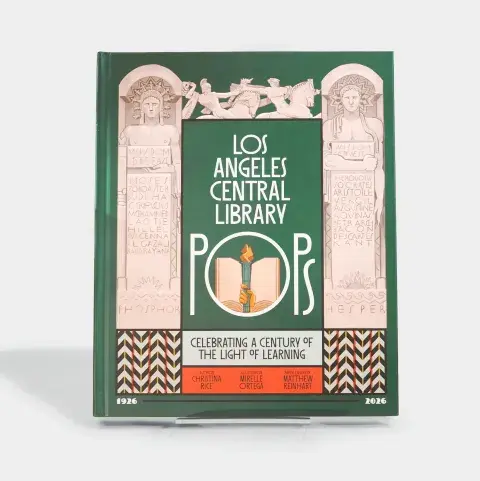
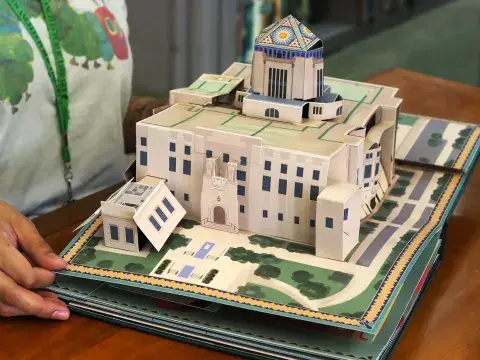
This year, pop-up books are playing an outsized role in the celebration of the Central Library’s Centennial, with several landmark projects taking shape through this unique medium. In June, Angel City Press published Los Angeles Central Library POPS: Celebrating a Century of the Light of Learning, an intricate pop-up book detailing the Central Library’s one-hundred-year history. Authored by Senior Librarian Christina Rice and illustrated by Mirelle Ortega, Los Angeles Central Library POPS animates the Central Library’s iconic features and history through this dynamic and sculptural book.
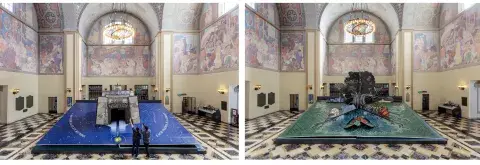
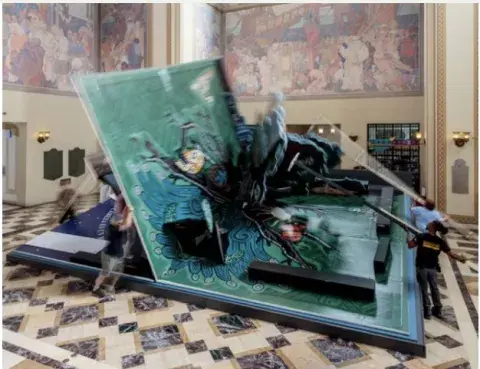
If that weren’t enough, we scaled things up with the new exhibition, Luceros y Penumbras: The World’s Largest Pop-Up Book. From July to November 2026, the Central Library’s rotunda showcases pop-up book mechanics and history, celebrating both the movable book art form and Los Angeles’s place in movable book history. The exhibition’s centerpiece is Luceros y Penumbras, a newly commissioned and fabricated work that has broken the Guinness World Records title for the world’s largest pop-up book. Measuring approximately 31 feet by 20 feet when open, with pop-ups rising more than 11 feet tall, and weighing over 1,800 pounds, Luceros y Penumbras contains two fully functioning pop-up spreads and is entirely made from traditional book-making materials, including paper, adhesives, and fabric.
Los Angeles-based graphic artist Daniel González authored and designed Luceros y Penumbras. The book features illustrations based on the artist’s original linocut prints. Its visuals and text illuminate the library as a guiding light of knowledge, and connect the history of L.A., the Library, and that of González’s own family in two monumental pop-up spreads. Prominent paper engineer Matthew Reinhart designed the pop-up mechanics for both Los Angeles Central Library POPS and Luceros y Penumbras. Reinhart worked closely with González to translate the designs from two-dimensional to three-dimensional. Using Reinhart’s mockups, the Pacoima-based Goodnight & Co. engineered, fabricated, and installed the pop-up in its final, massive form. Goodnight & Co. is known for its work building large-scale sets, props, and scenery for film, television, and award shows, notably the Oscars. In addition to solving the problems involved in scaling the book up in size, they were responsible for ensuring its functionality and stability, especially when the pages are turned. This feat is undertaken only monthly, since it requires a minimum of 10 to 12 people to execute safely and because each turn further wears the relatively fragile materials.
With this year’s excitement over pop-ups, it may be of interest to explore the history of the movable-book art form and its relationship to the Los Angeles Public Library and the city at large.
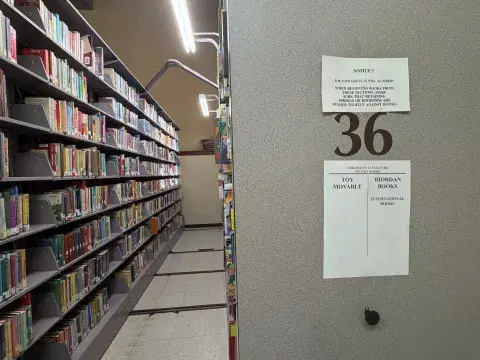
The Toy Movable Collection
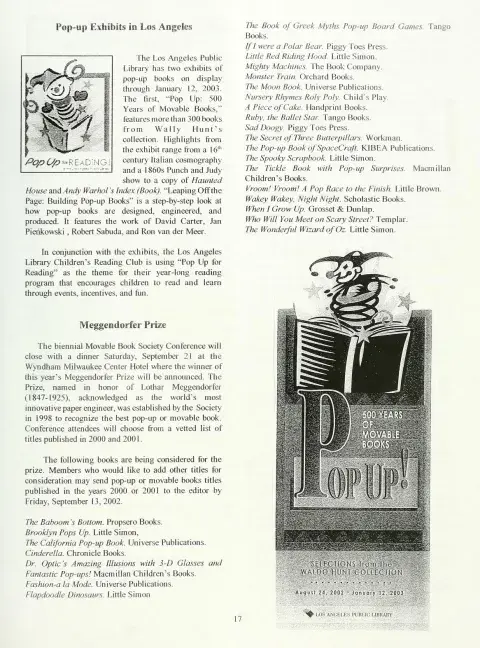
The Luceros y Penumbras exhibition features two display cases showcasing unique, rarely exhibited books from the Los Angeles Public Library’s Toy Movable Collection. In 2000, Children’s Librarians Mara Alpert and Tracy Taylor created this collection to steward the books that blend literature with the art of paper engineering for posterity. In 2002, the Central Library held an exhibition titled Pop Up! 500 Years of Movable Books. The exhibition showcased more than 300 titles from Waldo "Wally" Hunt's personal collection, whose story we will explore below. Today, the fascinating Toy Movable archive at the Central Library contains more than 2,000 movable and interactive books of various genres, intended for all ages and preserved for display, programming, and public research.

Background and History of the Movable Book
Pop-ups, pull-tabs, rotating disks, and scratch-and-sniff are just some examples of paper elements encompassed by the art form known as movable books. Paper engineering is the science that blends design and engineering to create these movable components that allow an interactive, dimensional, and sculptural page. Often self-taught, paper engineers design and hand-assemble mock-ups that are later used as guides in the large-scale production of simple or elaborate movable books. Through intricate design and engineering, the movable book encourages interaction among text, image, and the reader.
Over the last 800 years, movable books have changed and evolved—both in their paper engineering and mechanics and in their intended audiences. Early movable books known as volvelles date back to the 13th and 14th centuries in Europe and involved rotating paper disks to animate concepts ranging from astronomy to anatomy. By the 19th century, following the rise of European folklore and children’s stories as a literary genre, children’s book publishers incorporated interactive components such as paper flaps and pull tabs into the colorful illustrations of classic fairy tales. Wealthy families sought these innovative, movable books for their children, driving demand for books that combine play with learning. Notable pioneers of paper engineering during this "Golden Age" of movable books in Europe included German illustrator Lothar Meggendorfer (1847-1925) and German publisher Ernest Nister (1841-1906). The Library’s Toy Movable Collection features reproductions of Meggendorfer’s and Nister’s designs.
Following the outbreak of the First World War, the production of movable books declined as labor was diverted to the war effort. In the 1930s and 1940s, movable books experienced a modest revival, notably in England. In the United States, New York-based publishing house Blue Ribbon Books coined the term "pop-up" as a marketing strategy for their movable books, greeting cards, and advertisements. However, during this time, American movable books were rare and often poorly made. But starting in the 1960s, Waldo Hunt revitalized and revolutionized the pop-up book industry and art form, making Los Angeles, for a time, the center of pop-up art in the United States and beyond.
Waldo Hunt and Intervisual Books, Inc.
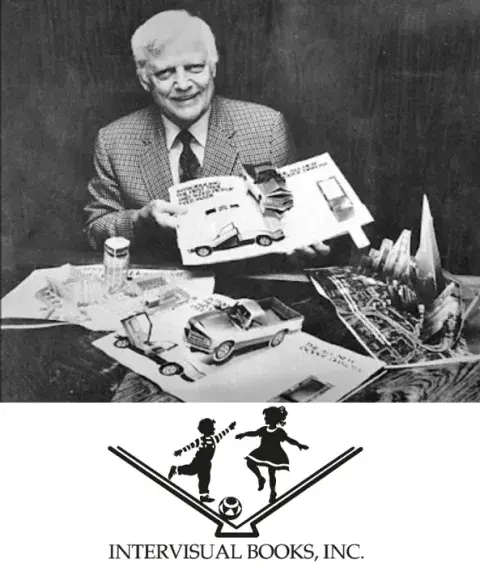
Born in 1920 in Chicago and raised in San Mateo, California, Waldo “Wally” Hunt served in the Army during World War II. Following the War, Hunt moved to Los Angeles to open an advertising agency. Hunt’s interest in movable books began when he observed displays featuring imported European pop-up books in toy stores along Fifth Avenue in New York. Those created by Czech architect and artist Vojtěch Kubašta (1914-1992) motivated Hunt to consider this unique and delightful medium. In 1965, he started Graphics International, an advertising firm that produced pop-up magazine advertisements and greeting cards. Within a few years, Hunt broadened Graphics International’s marketing materials to include hand-assembled books, creating books domestically in New York and Los Angeles and expanding production internationally to Mexico, Colombia, and Singapore.
Southern California: World Headquarters for Pop-Up Book Production?
In the late 1960s, Hunt sold Graphics International to Hallmark, and in 1973, he founded Intervisual Communications, which later became Intervisual Books. From the early 1980s to the mid 2000s, Intervisual increased the availability of innovative yet affordable movable books and helped make the term “pop-up” a household name. And with Intervisual’s headquarters based in Santa Monica, the region became known as the “pop-up capital of the world” during their heyday.
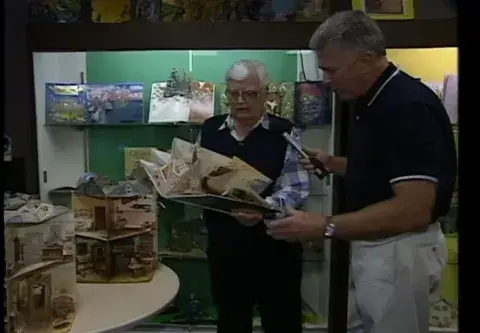
By 1996, Intervisual had produced 1,000 movable books featuring innovative paper-construction mechanisms. The company’s success inspired paper engineers to advance their designs and led to partnerships with major publishers and media franchises, including Disney, Random House, and National Geographic. Prominent paper engineers at Intervisual included Jan Pienkoski, Tor Lokvig, Ib Penick, David A. Carter, and Renee Jablow. Jablow worked at Intervisual for thirteen years and continues to create pop-up books, cards, and props in Los Angeles to this day.
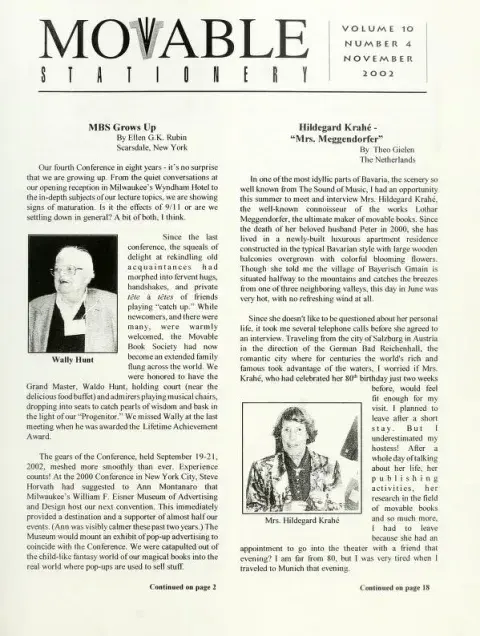
In 2002, Dalmatian Press, a children’s book publisher, acquired Intervisual, and in November 2009, Hunt died at 88 years old. Paper engineers and movable-book enthusiasts remember Hunt for his pivotal role in advancing movable-book engineering and its popularity in the United States, both in advertising and publishing, and he is often referred to as the "King of the Pop-Ups."
Today, members of the Movable Book Society continue advancing the art form. Founded in 1993 and with nearly 450 members worldwide, the Society connects artists, paper engineers, collectors, curators, and scholars to share knowledge, appreciation, and preservation of the art form.
As the latest chapter in this rich history, Luceros y Penumbras celebrates the Central Library as a constant light and source of knowledge, growth, and hope. The project aims to spotlight the inspiration, excitement, and curiosity the movable-book medium generates, and to continue promoting it at the Los Angeles Public Library for many years to come.
To view the Toy Movable Collection, please email children@lapl.org and include your name, phone number, and titles requested, and/or a brief description of your research topic. A librarian will contact you to set up an appointment.


