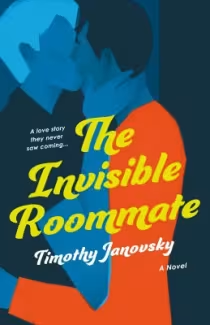
Interview With an Author: Timothy Janovsky

Timothy Janovsky (he/him) is a queer, multidisciplinary storyteller based in DC. He holds a Bachelor's degree from Muhlenberg College and a self-appointed certificate in rom-com studies (accreditation pending). When he's not daydreaming about young Hugh Grant, he's telling jokes, playing characters, and writing books. He is the author of Never Been Kissed, You’re A Mean One, Matthew Prince, and New Adult. His latest novel is The Invisible Roommate and he recently talked about it with Daryl Maxwell for the LAPL Blog.
What was your inspiration for The Invisible Roommate?
The Invisible Roommate was originally inspired by a conversation I had with my partner’s late grandmother. She was telling us a story about the ghosts that lived in the farmhouse she grew up in and said, “It was like having invisible roommates.” I stored that nugget away in a note on my phone. At first, I thought I might write a paranormal romance where a pop star on the run ends up bunking with a ghostly love interest, but then I got to thinking about the 1933 movie The Invisible Man and how campy it is. I thought I might be able to play with that concept in a romantic way. The more I noodled on the idea of falling for someone you could only hear but not see, the more I thought about the hit Netflix reality dating show Love is Blind, where contestants "date" each other from separate rooms using speakers to talk to one another. Something in my head just clicked! The characters sharpened in my mind, and the story spooled out from there.
Are Gerard, Emory, Regina, Kellan, or any of the other characters in the novel inspired by or based on specific individuals?
Emory Griffin is heavily inspired by Griffin in H.G. Wells’s original 1897 novel. Not only do they share a name, but they have the same reclusive nature and almost obsessive interest in their scientific work. Minus the streaks of malevolent violence!
Gerard is an amalgamation of a lot of male pop singers I’ve loved over the years, but I sort of modeled the band he’s in with his brothers, We the Wells, after the Jonas Brothers and AJR. There’s something very intriguing to me about a family making music and navigating success together. Where does the professional relationship end and the familial one begin?
At the time I was conceptualizing the book, I became interested in the American folk revival of the 1970s and happened upon Judee Sill, a singer-songwriter of the time who was inspired by Bach and used religious imagery and symbolism in her lyrics. This felt apt as a jumping-off point for the character of Regina, who becomes both a musical and spiritual guide for Gerard as he untangles the messy web of his love of music and crisis of faith.
How did the novel evolve and change as you wrote and revised it? Are there any characters or scenes that were lost in the process that you wish had made it to the published version?
The Invisible Roommate is my tenth traditionally published novel, and when I started writing it, I thought, “I’ve done this before. I know what I need to do in advance to make this process smooth.” I did a lot of preparation—re-reading the original H.G. Wells, researching the science behind potential invisibility in various species, learning about islands in the Chesapeake—and outlined the book with a strong conviction that I was going to stick exactly to my plans. Welp, that didn’t happen!
Not to spoil anything, but originally the climax of the story was meant to take place at a medical school reunion where Emory plays this big trick on his former classmates and proves his invisibility theories were possible after all. However, the characters had their own ideas. Since this book takes place in the lead-up to Halloween, the love story and the external pressure of Emory and Gerard being discovered wove together sooner than I expected, and a much quieter, more authentic reveal took place on the holiday itself. I then had to go back and rework parts of the story to lend more naturally to that, which only made the story stronger in the end and helped cement Iping Island as almost its own character in the novel.
Is Iping Island based on or inspired by a real place?
Iping Island is primarily inspired by the famed Tangier Island in both its geographic location in the Chesapeake and its history in American culture. I even wrote in the unique accent that combines an olden Cornish sound with hallmarks of the American South. I knew I wanted to set this story on an isolated island, so there was a bit of a Gothic vibe with a lot of forced proximity between our love interests. When I learned more about Tangier and its shrinking landmass, I knew that would add yet another key element to this story, which is largely about visibility and protecting the people and places we love.
When I’m writing fiction, and I find a setting that checks most of the boxes for the story I’m trying to tell, it never checks all the boxes. Naturally, a story needs space to breathe and become its own entity, and I knew the island would play such a major role in the story. Because of that, I looked to other small island communities in the United States to round out this tight-knit town where tourists take day trips in the summer, and the locals protect their own year-round. I wanted Iping to feel very much like the type of a place a reader might initially scoff at but ultimately want to visit by the end.
Gerard plays several instruments throughout the novel. Do you play any? If you do, have you named any of them?
I wish I were as musical as Gerard! I grew up doing musical theater and taking voice lessons. I dabbled in piano for a brief period, but I did not have the discipline or dexterity required for it. All the math involved in reading music was a big challenge for me as well.
I have always loved the tradition of musicians naming their instruments, though. In a way, it’s like how I approach naming my characters. Not only does the name itself tell us something about the character, but the character’s relationship to their name is important. Gerard embarks on a journey with his own name in this book, and Gerard naming his trusty guitar Pascal is an early signifier that this is a man who believes in the power of a name.
Is The Invisible Man your favorite of H.G. Wells’ works? If so, why? If not, what is and why?
The Invisible Man is definitely my favorite of H.G. Wells’ works because it deals with such complex themes of identity, morality, and fervent pursuits of the “impossible.” It takes a science fiction premise and tips it into this horror-fueled nightmare. It forces you to ask yourself, what would you do—or try to get away with—if you could go undetected by others?
Do you have a favorite "invisibility" story (novels, films, or television)? A least favorite (One that is so bad it is fun)?
My favorite invisibility story has to be the 1933 film The Invisible Man, most known as part of the main Universal Classic Monsters series. It departs quite a bit from its source material, but it has such a sardonic, dark humor and camp sensibility to it, which makes sense given it was directed by James Whale, who was gay. All around, it’s a perfect watch for spooky season. Dr. Griffin derails a train!
By no means do I think Fantastic Four (2005) is a good movie (it gets a shout-out in the book!), but I do have a special place in my heart for Sue Storm, aka Invisible Woman, played by Jessica Alba in that and its sequel, Rise of the Silver Surfer. First off, I think her powers are the coolest among the four, and her force fields really save the day. Also, Chris Evans as the Human Torch in the original was a bit of a gay awakening for me. I would definitely not be writing books like The Invisible Roommate without those defining early crushes.
There are some significant plot developments that occur at Halloween celebrations. Is Halloween your favorite holiday? If so, do you have a favorite memory, or two, of Halloweens you can share? If not, what is your favorite holiday?
Halloween is a holiday that has grown on me as I have aged. As a kid, I was not a big Halloween fan (even though I loved candy!) because even a scary sounds CD sent me running to hide under a blanket. Thank goodness for the advent of online shopping because that’s how I got most of my costumes as a kid. Even the thought of going into a Halloween store sent a chill up my spine. I was a much bigger fan of Christmas, where everything was jolly, joyful, and cozy, and even the ghost stories had happy endings.
Much of my aversion to Halloween I can now pinpoint as early signs of my neurodivergence. The sensory overload and inability to separate a real threat from a fake one meant only for fun caused me a lot of anxiety and discomfort as a child. It’s funny to think that I would grow up to write a novel like The Invisible Roommate because I think even the more gothic sci-fi-esque concept would’ve spooked me as a child. It’s even funnier that I wrote the character of Gerard into this novel as a lot of his personal journey has to do with coming to terms with his own neurodivergence. I think writing this specific character into a Halloween-centric story was a healing and cathartic experience for me.
What would be your idea of the perfect Halloween (where you could celebrate anywhere and with anyone)?
A perfect Halloween for me would be like the one I had last year with my soon-to-be husband. We baked Pillsbury sugar cookies with pumpkins on them, made maple bourbon cocktails, and watched a double bill of Arsenic and Old Lace (a classic Halloween romantic comedy starring the ever-dashing Carey Grant) from 1944, and It’s the Great Pumpkin, Charlie Brown! Light on the spooks, heavy on the cozy and the comfy.
In your Acknowledgments, you mention the research of Zihao Ou and his team and their work, which rendered a mouse’s skin invisible. How/when did you first learn about their work? Did you know about this prior to deciding to write The Invisible Roommate, or when you were preparing to, or writing, the novel?
Writing a character like Emory in The Invisible Roommate is a unique challenge for a writer like me who never much excelled at science. But as I prepared, I knew I needed to be smarter to do the character justice, so I did a lot of research on H.G. Wells’s original "science fiction" about optics and refractive indexes and then branched out from there to academic papers and then to current research. I was actually researching blood substitutes when I stumbled across the work of Zihao Ou and his team, who discovered a certain food dye could be used to turn the skin of a lab mouse transparent, creating a makeshift stained-glass-window effect that allowed them to see the mouse’s organs at work.
Funnily enough, my partner works for a science non-profit organization in editorial that processes and hosts press releases announcing new scientific findings. When I brought up to him at dinner that I had discovered this paper online, he was like, "Why does that sound so familiar?" Turns out, he had processed a release on the study during a shift months earlier! We had a good laugh about it.
If/when The Invisible Roommate is adapted to a film or series, who would your dream cast be?
In a dream adaptation of The Invisible Roommate, I would love to see Michael Johnston from the recent mega-hit horror movie Obsession tackle the character of Gerard. I think he has the right depth of emotion to really nail a pop star in search of a break and himself. It helps that he also is a singer-songwriter with a wonderful voice! For Emory, I’d love to see Sebastian Croft from the Heartstopper series. I feel like he has the right energy and delivery to give the snappish yet sensitive scientist character some real heart and charm.
What’s currently on your nightstand?
Currently, I have a copy of The Infinite Sadness of Small Appliances by Glenn Dixon on my nightstand. I am a sucker for a story about a personified object that is curious about the human experience. In this delightful little novel, it’s an iRobot-type vacuum cleaner who loves classic literature and music and is trying to understand emotion. I’m really enjoying its futuristic take on humanity and the place of technology in our lives.
What is the last piece of art (music, movies, TV, more traditional art forms) that you’ve experienced or that has impacted you?
The piece of art that stands out most to me recently is the new Gregg Araki film, I Want Your Sex. It’s a fever dream, farcical sex comedy starring Cooper Hoffman and Olivia Wilde that deals with workplace power, BDSM relationships, and how different generations approach sex and intimacy. There is commentary on the state of modern art and gender politics. I found its commitment to its message and the really embodied performance by Olivia Wilde to be so engrossing. As a queer creator who writes about sex and sexuality often in humorous or outlandish situations, I found it really inspiring.
Another piece that comes to mind is the album Stage Girl (Not A Dream Anymore) by trans singer Eli. I heard someone refer to her album as Disney Channel pop pastiche, and I knew I was going to love it. The music is unapologetically maximalist, borrowing heavily from Britney Spears, Mariah Carey, and other chanteuses from the early 2000s. The album’s aesthetics are influenced by early seasons of American Idol. It hits all my nostalgia buttons while still feeling so fresh and tongue-in-cheek.
What are you working on now?
I am currently working on edits for my next speculative holiday novel titled A Kissmas Carol. It’s a modern retelling of Charles Dickens’ A Christmas Carol that asks, What if Scrooge and Marley were more than coworkers? It has a Greek myth wrapping around it that I think will surprise and delight readers.