Interview With an Author: Marshall J. Moore

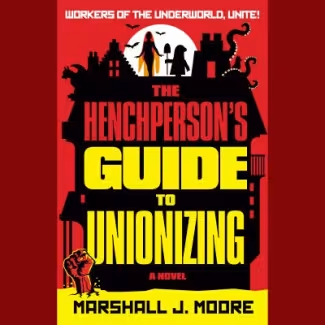
Marshall J. Moore is the author of the Son of a Sailor cozy fantasy trilogy, the Rites of Resurrection epic fantasy trilogy, and over thirty published short stories. His story "Red Lanterns" won second place in the Baen Fantasy Adventure Award Short Story Contest. When not writing or talking about writing, you can find Marshall teaching Muay Thai or reading at his home in Atlanta with his wife, Megan, and their two cats, Delilah and Furiosa. His latest novel is The Henchperson's Guide to Unionizing, and he recently talked with Daryl Maxwell about it for the LAPL Blog.
What was your inspiration for The Henchperson's Guide to Unionizing?
I was in a low place in late 2024, both due to world events and having received multiple passes from editors on the book that landed me my agent, and which I was certain was going to finally be the one that allowed me to make the leap from the indie publishing world to traditional publishing. After a particularly kind (and therefore infinitely more crushing) rejection, I started trying to brainstorm what my next project might be. I decided that I wanted to write something that was both fun and would inspire a sense of solidarity and hope amongst readers, which I sensed would be badly needed following the outcome of the 2024 presidential election.
Having recently read John Wiswell's Someone You Can Build a Nest In, I was intrigued by the possibility of writing something that combined the intimate emotional stakes of cozy fantasy with the trappings of Gothic horror, of which I'm a lifelong fan. I'd already written an unpublished short story some years ago about Igor realizing that he was being poorly treated by his mad scientist boss, and upon rereading it, realized that the concept was strong enough to expand into a complete novel. Much of that original short story made it into the final version of the book—the "pristine condition" joke about the tax collector's brain, for example.
Are Igor, Grim, Cornelia, Laura, or any of the other characters in the novel, inspired by or based on specific individuals (beyond their genre counterparts)?
The most direct inspiration for any existing character in the book is Grimalkin, who is visually almost a one-for-one copy of my cat Delilah (except Delilah's eyes are green rather than Grim's yellow ones). The rest of the cast are pretty much just me following their genre counterparts to their logical extremes.
And while I'm fortunate to have never had a boss as terrible as the ones in this book, I've been in enough workplaces across a variety of industries to have witnessed much of the behavior displayed by the Doctor, the Count, and Auntie Mag, albeit of a significantly less apocalyptic scope.
Similar question for Spare (because I think there may be a story there)?
No, actually! Spare was one of those happy accidents that occurred during the drafting of the story. Early on in the outlining phase, I had a vague idea that Igor would have an adversarial relationship with the Frankenstein's Monster-style Subject he and the Doctor were creating together. This conflict would culminate in the reveal that the Subject was meant as Igor's replacement, in what I intended would be an analogy for labor displacement due to generative LLMs.
Instead, as the story evolved, I realized that it would be a stronger narrative choice for Igor to emulate the Doctor by creating his own rather oddball, misfit Subject in the childlike, one-eyed, nonverbal Spare. This gives Igor a parental role in the found family that he and the rest of the cast are building, while also forcing him to rethink the ethics of bringing a thinking, conscious being into the world—as well as the responsibilities owed to said creation.
How did the novel evolve and change as you wrote and revised it? Are there any characters or scenes that were lost in the process that you wish had made it to the published version?
My agent and I went through several rounds of revisions to the book before we ever submitted it to a publisher, all of which were extremely needed to help tighten the pacing of what was initially a fairly episodic story. The final version is much improved for it.
The biggest change to the plot from that initial draft is that, in the first version, the henchpeople unite against their bosses almost immediately, formally declaring themselves a Henchperson's Union within the first dozen chapters or so. I much prefer the finished version, which allows their relationships to develop far more organically.
There were also initially three vampiric brides of the Count, meant as an homage to the trio of vampiresses in the original Dracula novel, and named after the actresses who played them in the 1931 Bela Lugosi adaptation: Cornelia, Dorotea, and Geraldine. Cornelia's storyline was much the same as it appears in the finished book, while Dorotea and Geraldine had dealt with their unhappy marriage to the Count by becoming a couple themselves. However, this left the pair with very little to do during most of the scenes they appeared in, and I regretfully removed them from the narrative. Happily, I was able to retain the sapphic romance element by changing Cornelia's love interest from Lawrence to Laura—an obvious change in retrospect, once I realized that Laura's storyline was particularly well-suited as an allegory for being closeted.
Igor is a classic horror character who works for, and has encounters with, several other classic characters from horror (vampires, a Frankenstein's monster, a mad scientist, a witch). Was it fun to take such well-known characters and play with their "rule books" to make them your own for The Henchperson's Guide to Unionizing? Was it intimidating? A bit of both?
Definitely a bit of both, but one of the fun things about working with such iconic monsters is that they've infiltrated the public consciousness to such a degree that you can do almost anything with them without straying from their recognizable archetypes. What better testament to the sheer range of vampire characters than the fact that Sesame Street's Count Von Count and Nosferatu's Orlock fall comfortably within that same umbrella?
Like with any magical element, the challenging part of playing with these classic monster archetypes was discovering what their limitations were and how the characters would struggle with them. Cornelia is a vampire, with all the powers that imply—incredible strength and speed, near-instantaneous short-range teleportation, and unnaturally long lifespan. But in addition to the fatal sunburns, deadly garlic allergy, and sanguinary diet, she's also forced to obey the commands of her vampire sire (and neglectful spouse), the Count, all of which combine to present an interesting and challenging difficulty for her to overcome as she tries to extricate herself from their unhappy relationship.
Similarly, much of the book's plot coincides with Igor's work on the Subject, an amalgamated corpse the Doctor intends to bring to life via mad science. I needed to have both a clear (if uneven) division of labor for this monumental undertaking, as well as tangible work for Igor to pursue. It became clear pretty early on that Igor would be tasked with all the hard, thankless, manual labor: robbing graves, stitching together limbs, dissecting corpses, etc. Meanwhile, the Doctor sequesters himself in his study pursuing the noble art of alchemy, which we learn as the story goes on is meant to form a sort of mental template for the Subject's eventual disposition by balancing its humours. Essentially, I decided to approach the creation of the Subject like building a computer, with Igor in charge of sourcing and assembling its hardware but the Doctor jealously guarding the development of its software.
Do you have a favorite classic monster? A favorite classic monster story (novels, films, or television)? A least favorite? One that is so bad it is fun?
Classic Monster: Surprisingly, considering that I couldn't find a way to work him or even any homages to him into the story, the titular Creature from the Black Lagoon. I'm a sucker for anything aquatic-themed, and the Creature's demise imbues that particular black-and-white creature feature with a sense of tragedy that truly elevates the movie.
Classic monster story: There's no beating Mary Shelley's original Frankenstein. The fact that two hundred years later we're still interrogating the ethics of creation, and the responsibility we owe to that which we've brought into the world, is an incredible legacy for her to have left.
Least favorite: This might be stretching the definition of "monster," but Andrew Lloyd Weber's Phantom of the Opera sequel Love Never Dies completely removes all nuance and ambiguity around Christine and the Phantom's relationship and is an utter character assassination of Raoul. And why, after the Gothic grandeur of the Parisian catacombs, would the entire cast relocate themselves to Coney Island, of all places?
So bad it's fun: Honestly, I went into 2008's Dance of the Dead expecting it to be this, but instead it ended up being a tightly-written, genuinely funny low-budget indie horror-comedy about zombies attacking a prom that I genuinely loved.
Your biography says that you currently live in Atlanta, Georgia. Do you have any favorite places? A hidden gem that someone visiting should not miss, but would only learn about from a resident?
Atlanta is currently undergoing a bit of a renaissance in the independent bookstore scene, which I'm absolutely delighted by. Three I want to shout out in particular are Eagle Eye Books, which has an incredible slate of author events throughout the year (and I'm not just saying that because they're hosting my launch event in September!); Long Story Books, which doesn't open until later this summer but has a unique book vending machine in Krog Street Market; and Book Nook, an endless labyrinth of used and vintage books I could (and have) spend hours getting lost in.
What do you think it is about Horror that draws you, as an author and/or reader, to these types of stories?
I think that, at least in part, it's because there's an element of taboo inherent to horror.
I wrote Henchperson's Guide with the intent of making it a horror analog to cozy fantasy books like Travis Baldree's Legends & Lattes and Sarah Beth Durst's The Spellshop. But the core conceit of Henchperson's Guide is that it revolves around freeing oneself from toxic, oftentimes abusive relationships, which might be too tonally too dark for a more mainstream cozy fantasy.
But by positioning Henchperson's Guide as a cozy horror, the audience is already invited to expect a level of transgressiveness and taboo content, making them much more receptive to the interrogation of abusive relationships that lie at the heart of the book's narrative.
The Henchperson's Guide to Unionizing would make a marvelous film or series! If/when it is adapted, who would your dream cast be?
Aw thank you kindly! I've actually thought about this a lot, and my first pick for Igor would be Gaten Matarazzo. His performance as Dustin in Stranger Things shows he knows how to play an earnest and lovable outcast, and I think his openness about and advocacy for his cleidocranial dysplasia would lend him an added element of empathy for Igor's own physical disabilities.
For the Doctor, Andrew Scott—not so much because he's already played another mad genius as Sherlock's Moriarty, but because he has exactly the sort of unhinged charisma that makes it easy to understand why Igor would follow him barefoot into Hell—not to mention how facilely he shifts between charm and menace.
Cornelia's the one I've thought about most, since as a vampire in a centuries-long stifling relationship, she's both visibly youthful and in some ways rather naïve, while simultaneously being able to portray hundreds of years' hardship and experience. After watching her turn as Alice in Shrinking, that combination of vulnerability and emotional fortitude feels like a natural fit for Lukita Maxwell.
The core conceit of the Count is that he's an incredibly average, underwhelming guy with an overinflated sense of his own self-importance, which would make for a fun twist on Josh Radnor's everyman typecasting. Oh, Ted.
Grimalkin would be played by whichever beautiful gray tabby best fits the part, and voiced by Lake Bell, whose rendition of Poison Ivy carries the perfect amount of wry aloofness and guarded affection as my favorite eldritch feline.
This one feels particularly like a reach, but I can hardly think of anyone better suited to portray Auntie Mag's blend of surface-level charm, passive aggression, and exasperation than Olivia Colman.
Never Have I Ever is one of the most delightful teen comedy series of recent years, and I think that Lee Rodriguez could bring the same blend of humor, awkwardness, and sweetly sapphic romance to Laura as she did to Fabiola.
What's currently on your nightstand?
My Kindle, and a plastic statuette of a pachycephalosaur that I got from the Smithsonian when I was six years old.
Can you name your top five favorite or most influential authors?
JRR Tolkien, CS Lewis, Bill Watterson, Ursula K. Le Guin, and Jim Butcher.
What was your favorite book when you were a child?
Any and every Calvin & Hobbes collection, particularly Weirdos from Another Planet and Yukon Ho!
Was there a book you felt you needed to hide from your parents?
Oh man, there's a scene in the Star Wars: Shadows of the Empire novelization where an alien crime boss attempts to seduce Princess Leia via mood-altering pheromones. The scene cuts out before anything racy can actually occur, but at age eleven, I was terrified of my parents finding out about it.
Is there a book you've faked reading?
Not a book per se, but every year for finals, my university theatre department made each class of students perform oral examinations discussing three plays randomly selected from a pool of about thirty, most of which were quite obscure. So each year before the day of the exam, the entire class would cram into a study room and give each other a crash course on these thirty plays we absolutely had not had time to read, so that we'd all have at least a surface-level understanding of their plots and characters—enough to improvise our way through the oral examination.
As far as I know, none of us ever failed the exam. And in all fairness, learning to bullshit convincingly is one of the most useful skills a B.A. in Theatre can impart.
Can you name a book you've bought for the cover?
Loads of them, but the first one that comes to mind is Black Sun by Rebecca Roanhorse—and what a delight to find that the contents were every bit as engrossing as the cover was gorgeous!
Is there a book that changed your life?
Sometimes I think I'm nothing more than an amalgam made up of little pieces of all the books I've read. But if I had to name one that's had a profound impact on me, CS Lewis's The Screwtape Letters is probably the most singularly responsible for cultivating my capacity for self-reflection and interrogation of my own actions, motives, and desires.
Can you name a book for which you are an evangelist (and you think everyone should read)?
Similarly, I'll never stop thinking that Lewis's Space Trilogy doesn't get the attention it deserves (Perelandra especially), but I absolutely and unequivocally recommend his A Grief Observed to anyone and everyone who's experienced the loss of a loved one.
Is there a book you would most want to read again for the first time?
Oh man, this is a hard one. Off the top of my head, I'm going to say Gideon the Ninth, because I want to experience all its jokes and magnificent foreshadowing again with fresh eyes.
What is the last piece of art (music, movies, TV, more traditional art forms) that you've experienced or that has impacted you?
As a certified 90s kid, I grew up reading K.A. Applegate's Animorphs series of middle-grade novels, which ran for 54 volumes from 1996 to 2001 (alongside 10 tie-in and spin-off books). I recently reread the entire series for the first time in a quarter century, and was absolutely blown away by how well they hold up as some of the finest antiwar science fiction ever written—and from a purely craft perspective, they're a masterclass in writing an ensemble cast. The series ends on a controversial, rather depressing cliffhanger, one that I found just as emotionally affecting as I did when I read it for the first time at the age of ten.
What is your idea of THE perfect day (where you could go anywhere/meet with anyone)?
My dad was my role model and my hero. He passed away unexpectedly from a heart attack at just fifty years old, a few months shy of my high school graduation. Some of the most special memories I have of him are of SCUBA diving together in Micronesia. I would give anything to have one more clear, sunny day of tropical diving with him.
What is the question that you're always hoping you'll be asked, but never have been?
Over the last thirty years or so, I've experienced a sharp and regrettable decline in the number of inquiries as to my favorite dinosaur.
What is your answer?
Ankylosaurus.
What are you working on now?
I'm about to start on edits for my next book, which is something of a companion piece to Henchperson's Guide, though this one is less horror and more of an homage to cult classic fantasy epics like The Princess Bride. While not a sequel, the two books share a similar DNA of humor, deconstruction, and exploration of familiar tropes, and an unlikely found family of misfits. However, where Henchperson's Guide is about recognizing and freeing oneself from toxic relationships, this book is about realizing when you've been the villain in your own relationships, and is focused on seeking redress, making amends, and finding the limitations of forgiveness.
Also, one of the characters is a talking axolotl.