Laughing Owls Redux: An Interview With L.A. Poet Lynne Thompson


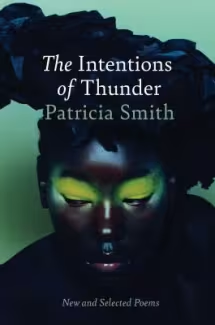
During Lynne Thompson's term as the Los Angeles Poet Laureate from 2021 to 2022, Thompson curated Poems on Air, a weekly podcast wherein Thompson read a poem by some of the biggest names in American poetry, such as Terrance Hayes, Joy Harjo, Diane Seuss, and Patricia Smith, just to name a few.
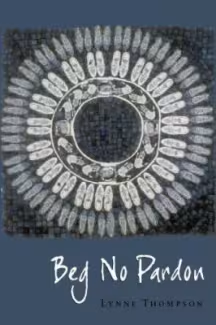
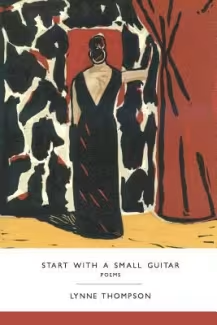
Lynne Thompson’s Beg No Pardon, her first book, won the Perugia Press Prize in 2007 and the Great Lakes Colleges New Writers Award in 2008. She’s also the author of Start With A Small Guitar (2013) and Fretwork (2019), winner of the Marsh Hawk Poetry Prize. Thompson is the recipient of multiple awards, among them an Individual Artist Fellowship from the City of Los Angeles. Her work has been widely anthologized, including in The Coiled Serpent: Poets Arising from the Cultural Quakes and Shifts of Los Angeles, X LA Poets, and Best American Poetry 2020. Thompson serves on the boards of Cave Canem and the Los Angeles Review of Books, is Chair of the Board of Trustees, Scripps College, and serves as the inaugural Perugia Press Poet Liaison to the Board, a conduit between poets and the board and a mentor to the latest winning poet.
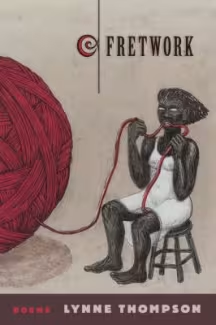
This interview begins with Thompson's third full-length collection, Fretwork (2019), as it delves into origins, lineage, and personal history. In that collection, readers can feel her family members move from the island country of Saint Vincent and the Grenadines in the Caribbean to New York City, then to Chicago, and finally to Los Angeles, where Thompson was born. But specifically, I zoomed in on the poem "Fretwork," which I assume inspired the book's title. There are three generations of women in this poem: Thompson, her mother, and her grandmother. The poem is set in her mother's birthplace, Bequia, one of the Grenadine Islands. The poem is set at night-time in a bedroom with a mosquito net, where a little girl tries to hide in a drawer, away from mosquitoes, because her mother said mosquitoes could eat them up. The poem underscores fear from a child's perspective, as she imagines something monstrous about to engulf her life out of existence. That's why she wanted to save herself. But in the midst, she noticed "a bauble of moon glistening off the fretwork." Often made of intricately carved wood to create stunning effects, fretwork is a feature of Victorian architecture, especially in middle-class homes, that adds decorative patterns to room dividers, railings, or window frames. In the poem, the fretwork is a window frame that serves as a boundary between a bedroom and the outside world. And surprisingly, the worst part, here, is the moon, since it's just a "bauble," like a cheap trinket; its light is not powerful enough to illuminate and reach the darkness in the room, which only deepens the drama in that bedroom where the child is, and certainly the house.
In the poem "Fretwork"—in your third collection—does the idea of 'fretwork' constitute a boundary of sorts, a kind of border between fear and salvation, and a space where light feels decorative and ornamental? Where maybe certain aspects of the past don't quite shed light on the present, because these elements, to an extent, emit characteristics comparable to just a "bauble of moon," not quite a glimmering light, not illuminating enough?
LThompson: Oh, Michael, I'm so glad you zeroed in on the poem "Fretwork" because it does concern the issues you identified: fear, salvation, the past versus the present. Although it isn't obvious in this particular poem, the collection addresses the speaker's curiosity, dread, and ambivalence about the fact of her adoption. So poems like "Composition #1," "Petition," and "Chord" are very much in conversation with the poem "Fretwork," which hints at a difficult relationship between my mother and grandmother ("and whether she was pleased to see her daughter and me, she kept it to herself.") Even the Derek Walcott epigraph to the book was selected to emphasize the boundaries you speak of: "We have no solace but utterance, hence this wild cry."
Fretwork
By the time Mother took me to her birthplace—Bequia—
I was a fifth-grade wordsmith in a first-grader's body.
H-o-m-e—too easy—fell off my spelling list, although
I didn't know what home meant. I didn't recognize my
Mother's mother, who was the color of pitch and whether
she was pleased to see her daughter and me, she kept it
to herself, a mystery. "Tonight," Mother said, "we'll sleep
under cotton netting to keep the mosquitoes from eating
us up," and, like that of the man who delivered his catch
in the early light, her voice echoed. Later, as Gran's house
went dark, a bauble of moon glistening off the fretwork,
Mother found me atop a chest of drawers—(I knew how
to save myself, opened each drawer, more, and then more,
then scaled each one, musty with a scent of lies and Hazell
history)—shivering in the night's damp air. When she asked,
I said I was hiding from the mosquitoes. When I saw my first,
on a screen, I frowned. "How do they eat you up?" "Nothing's
as you imagine it," Mother said, and she wasn't speaking to me.
The poem "Chord" is particularly alarming, from my point of view, much darker than "Fretwork," because now the mother figure, your mother figure, has passed on. The weight of grief is centered on the absence of a sense of farewell: "She didn't ask for me / when she saw all of it ending / so I don't know how she went out." But more so: "she never knew what I've become." What's so stark about the emotions you tried to convey here is that it feels like you chose not to "not go to her," or perhaps refused to say goodbye. And by refusing, a 'chord' is severed? Is there a sense of liberation here? Perhaps liberation from family bonds that were a source of pain with "no solace but utterance, hence this wild cry"? To borrow Walcott's line. The wild cry is the refusal to go to the mother figure?
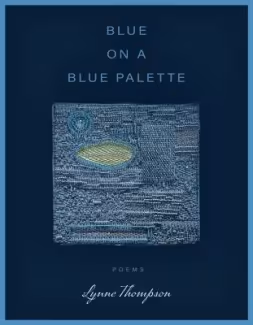
LThompson: It's important for readers of Blue on a Blue Palette to understand that the mother in the poem "Fretwork" is the speaker's adopted mother, while the mother in the poem "Chord" is the speaker's birth mother. There, in section I of the poem, the speaker is mourning and angry that her birth mother had the opportunity to say something to her before she died and declined to do so. However, the speaker realizes in section II that she, also, must bear some culpability for her own failure to reach out to the woman who birthed but did not raise her. That realization may be a sort of liberation; however, to my mind, in the end, the speaker is resigned to a dark reality. Thus, the Walcott quote that opens the collection applies in that there is no solace but the opportunity to give language to the difficult circumstance in which the speaker finds herself.
Chord
for Beverly
I
She didn't ask for me
when she saw all of it ending
so I don't know how she went out.
Whether she wept or sang
Precious Lord or I Wish I Knew,
she didn't ask for me.
Perhaps she asked for nothing—
nothing being what she once chose.
I don't know how she went out—
whether dreaming of my father
or of the revulsion she had for her own,
she didn't ask for me.
She could have left one suggestion—
she didn't, and maybe she died hard.
I don't know how she went out.
Whether dreaming of me or furious
she was at the end of dreaming and
left with one last choice: not to ask.
I don't know how she went out &
II
I must tell you this: I did not go to her
before her breathing became shallow
so she never knew what I've become—
that, as another's daughter, I did long.
Still, dressed in apologies and alibis,
I did not go to her—
my feet stuck in the sludge 1
of my other mother's don't do this to me.
She never knew what I've become.
She never knew and no one's to blame.
Why can't every choice be just a choice?
Because I didn't go to her
and why not?—continually—and
even then, I didn't. What is that?
Even I don't know if I've become
a liar, always fire in the grate, or some-
one else's reason to be grateful but that's
not good enough. I did not go to her.
Anyone can see what I've become.
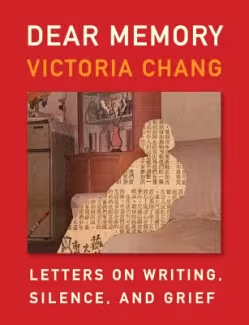
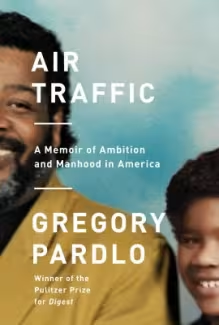
The way you're referencing speakers between your books makes me think of something some poets have indulged in: the memoir. For example, Victoria Chang has done it with Dear Memory: Letters on Writing, Silence, and Grief (2021), Gregory Pardlo with Air Traffic: A Memoir of Ambition and Manhood in America (2019), and many others. Have you ever considered writing a memoir, or perhaps it's a work in progress already, that you're currently drafting in your mind? Your poems are layered with stories: about another land, your father's journey to the United States, then that hospital where your body moved from one mother to another. Any temptation to indulge your words in details that sometimes make memoirs page-turners?
LThompson: Yes! I am very intrigued by the memoir form. In many ways, I approach the "unmasking" you speak of but, of course, in poems where I can "hide" using metaphor and other literary devices to put—as I think of it—a pane of glass between me and the reader. Am I ready to go bare-bottomed as my grannie would have said? Equally important to me is finding an original or unique "way in". My friend, the poet Patricia Smith, reminds writers that whatever any of us wants to write about, every other writer wants to engage in, as well. So if, in memoir, we're all addressing the same subjects—death, family, sexuality, faith (or lack of it), how do we make the telling uniquely ours? I'm intrigued with your idea of "the movement of my body from one mother to another"—and maybe it's also time to put the fathers in the frame? Time will tell but I'm grateful to you for the nudge!!
I'm so glad you mentioned your father, since his spirit is all over your work. In fact, when you were interviewed by Marsh Hawk Press (one of your publishers), you underlined how connected he was to you, that you "will always be the daughter not of his body but of his heart." Now it's hard to ignore the poetry organically embedded in that line. Is it fair to say that your father passed something to you that made you want to be a poet? And with regards to his journey from the Caribbean via Barbados to the United States, I'm curious why he chose a journey to the States in 1923, and not the United Kingdom; being from Saint Vincent and the Grenadines, which was still part of the British Empire when he left, one would assume that he had eyes for the British Isles. Why the U.S. and not the U.K., as his point of destination? In fact, part of him was quietly averse to his American environment and "favored the King's English over the colloquial," to borrow a line from one of your poems, "Emigré," in Fretwork.
LThompson: Thanks for asking about my father who was, as you've recognized, a major influence on my decision to pursue poetry seriously. First, as to your question about his decision to emigrate to the U.S. rather than the U.K. I believe that, as with many immigrants, you tend to travel somewhere you have friends or family. In this case, my mother's aunt Ida (Tantie, as she's referenced in many of my poems) was already living in the States, and Daddy knew her through her sister, with whom he lived while teaching on the Grenadian island of Bequia. Complicated enough? Most immigrants' stories are! In any event, he didn't lose his love of language generally and poetry specifically when he settled here. He used to read me poetry from time to time and even scribbled a bit himself. One of his poems is extant and I have a copy of it framed: "Awake! Awake America!/New World and Old World too!/Awake, oh white `humania',/black, brown, and yellow too". He was clearly interested in admonishing America about its stance with respect to its people of color, and I'm grateful he passed that sensibility and concern on to me.
Your father's interest in admonishing America, in this respect, feels like a hint of activism, which, in addition to poetry, he must've passed on to you as well, and is now amplified in your role as mentor to emerging voices and leaders on the boards of major institutions like Cave Canem, the Poetry Foundation, and The Los Angeles Review of Books. And, too, somewhere in this narrative of activism must be a desire to study law, because a few years after earning your bachelor's degree in Social Psychology at Scripps College in 1972, without too much hesitation, you went to law school in 1976. I have a feeling you were already aware of the connection between law and poetry and of how language plays a significant role in both fields. And that you were already organizing your life, subconsciously, when you pursued law first, then the life of a writer later? Did you miss the life of being a lawyer, especially the drama and melodramas of the litigation process?
LThompson: If this were a live interview, you would see me laughing uncontrollably! Your comments and questions make me sound so much more organized and strategic than I was when I entered law school. Although I'd loved poetry all my life, I wasn't thinking about it when I entered school. I should have guessed where I'd end up, however, when early in my career as a litigator, I filed a motion on behalf of a client and the judge promptly dismissed it. But he did so, saying "though it's wrong on the law, the language in your brief is beautiful and creative"! So yes, the poetry was always screaming and kicking to get out, and, of course, the link between the two is always, always language. Unlike the law, though, where language is meant to persuade by its argument, poetry persuades by its lyricism, which I love and why I don't miss the law's melodrama!
No doubt that the judge bookmarked your affinity with language and creativity. Now, when it comes to lyricism and the internal music of poetry, do you gravitate to certain poets for inspiration, wisdom, and nourishment? Do you carry a small notepad with you, to jot down lines to work on later? Can you give us a hint of how most of your poems come into being, your process?
LThompson: When I think of my process, it's a little like the cento form I so admire. A cento—a patchwork or quilt as loosely translated from Italian—is a poem composed of lines from another poet or poets to make a completely new poem. I write centos often and my process of writing generally is something of a patchwork. Often, the idea comes and as I'm pursuing it on the page, I think I need to "mix it up" a little to break the narrative. That need might get fulfilled from something I'm reading or researching or something I've heard. That's what happened in When Nothing Else Will Do when I wrote:
All I want is for my hair to a n e m o n e
& the not wanting to go for brokewhile I drink honey bourbon and listen
again then over again Not A Day Goes By
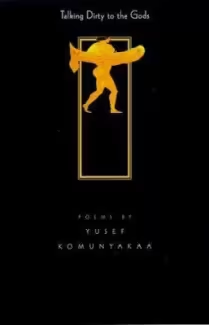
So, as you've asked, I do carry a notebook with me because I never know when a snatch of overheard conversation or something on a billboard may prove to be unexpectedly useful in a poem. But however I may veer down a byway in a poem, its internal music is always of primary import. And when I think of one influence in this regard, that poet would be Yusef Komunyakaa. Read the following aloud:
We washed away the live perfume
Of others, removed lush memories
Of their hands, trying it ignore kisses
Burning in our mouths…
"Epithalamium"
Transported by the lyricism, yes?
Transported absolutely! The idea of starting over on wedding night, and cleansing a union from the "live perfume / Of others" is so haunting, and beautiful. It's quite obvious that you love the cento, because, I believe, you've read them all, which means you can hand-pick from memory which lines to include in future poems you want to compose. Now, if I may take the idea of lyricism to another point: do you think you've found happiness in the internal music of poems you have written and read? Have you found a sanctum and private space for perfect happiness there? What is your idea of perfect happiness?
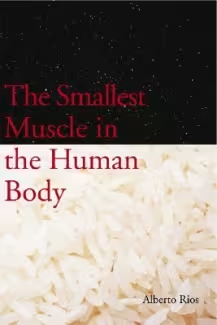
LThompson: While my idea of perfect happiness certainly isn't limited to poems—I'm thinking of spending the afternoon on Princess Margaret Beach in Bequia, my mother's island home, or of attending a musical concert featuring composer/performer Rhiannon Giddens or cellist Sheku Kanneh-Mason—but yes, yes, the lyricism of poetry always holds me captive. Right now, I'm thinking of my favorite poem of Alberto Rios, "Refugio's Hair," and of these lines:
When they reached the trees and went under,
Her hair, which had trailed her,
Equal in its magnificence to the tail of the horse,
That hair rose up and flew into the branches
As if it were a thousand arms,
All of them trying to save her.
Every time I re-read the Rios poem, that reading is a kind of perfect happiness.
The image of hair "as if it were a thousand arms" is stunning, and gives Refugio a mythical dimension. Now, if poems can deliver a weather of happiness in the imagination, can they deliver bad weather as well, say, fear perhaps? What do you fear? As a writer, do you fear the lack of time to finish future writing projects? What's your greatest fear?
LThompson: Of course, as writers, I suspect we all fear that we won't be able to complete the myriad projects rolling around in our heads. Just comes with the territory, I think, but also that fear can (and does, in my case) act as a galvanizing force that keeps us writing even when we'd rather be doing something else. But my greatest fear—not that I won't have enough time to write everything I'd like to; rather, that there won't be enough time. Full stop.
Time, yes. Now poets write persona poems, and assume the voice of another person. You had written a number of them. In "A Sorceress Strolls New Grass," you are "vainglorious with all my knowing and croaking." If you were to die and come back as a person or a thing, what would it be? Who would you be? A sorceress? Jesus Christ? Your grandmother? Or a pen that will never run out of ink? And why?
LThompson: The pen that never runs out of ink is compelling! I'd love to think the stories I want to tell will continue to be told long after I've become one with the ether—where I will, of course, turn into a laughing owl (ninox albifacies), last seen in 1914 (Wikipedia)!
Wow. An owl! Somehow, you've made a perfect alignment here, since owls are the unofficial symbols or mascots for writers! And with regards to young and not-so-young aspiring writers who attend your workshops and classes, what kind of information, stories, or ideas do you impart to them beyond the knowledge of technical skills?
LThompson: A foremost goal when I conduct classes or workshops for emerging writers is to emphasize that communality of what all writers do, whatever stage their writing practice, to remind them that we all "start with a blank page [or screen] as Robert Hass once said to me. I will often tell attendees of my journey from lawyer to poet and stress the point that I didn't get an MFA or Ph.D., the point being that, while useful, those aren't the only ways to develop one's craft. Frequently, I give (as I did this summer at Idylwild's Writers Week) a craft talk on the art of submission and what to do with poems when they're ready for public dissemination. I've found this is popular, as aspiring writers don't know how to begin to approach this task or what issues/questions they should consider. It's very gratifying to get notes from first-time submitters who've had work accepted; I know I'm doing something useful!
Some writers feel that talking about their future projects might jinx them. Do you feel the same? Can you give us a hint of your current or planned projects? Collabs with other authors perhaps?
LThompson: I guess I am a little hesitant, though I didn't realize it until you asked! For the sake of being responsive, let's say that, in addition to poems, I'm considering writing in other genres: memoir, playwriting, short stories….
Do you abide by some guiding idea, in general, within and outside writing? What is your motto?
LThompson: My motto is not have a motto. For me, it would be too restrictive. I want to be open to possibilities that a motto might not have considered.
Who are some of your favorite writers within and/or outside the world of poetry, and why?
LThompson: The first persons who came to mind outside the poetry world are Imani Perry and Annette Gordon-Reed for non-fiction and then, of course, the novelists Percival Everett and Colson Whitehead. Poets are too numerous to name—and will get me in trouble!
Describe some of the best places or settings where you like to read. Do you have any? Is it at 10 p.m., a few hours after dinner, by a window, on your favorite chair? Or right after a social event or public reading, and you need to sink deep into silence, to another world inside, instead of sleeping?
LThompson: I love early morning before the traffic on the street picks up. I love to hear the birds at first light. I get the feeling I'm alone on the planet with only the words on a page for comfort.
What's on your reading pile, or reading list? What are you currently reading?
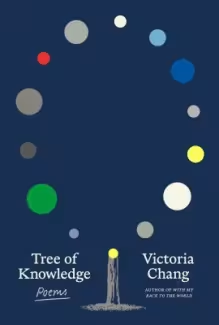
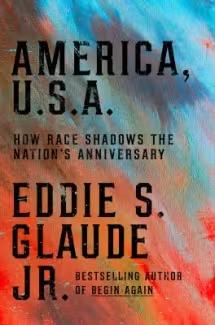
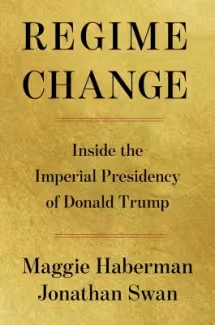
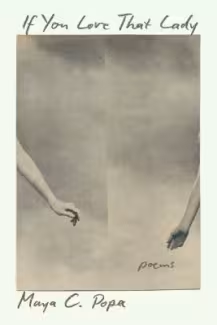
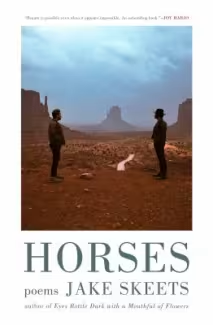
LThompson: I'm very excited to read Matthew Shenoda's forthcoming Holdings. I was lucky enough to read Maya C. Popa's If You Love That Lady in galley, and I recommend it highly. Recently added to the nightstand: Aaron Coleman's Red Wilderness, Jake Skeet's Horses, Victoria Chang's Tree of Knowledge, and Eddie Glaude, Jr.'s America, U.S.A. How Race Shadows The Nation's Anniversaries. Oh, and I'd be remiss if I didn't confess I'm listening to Maggie Haberman's and Jonathan Swift's Regime Change.